
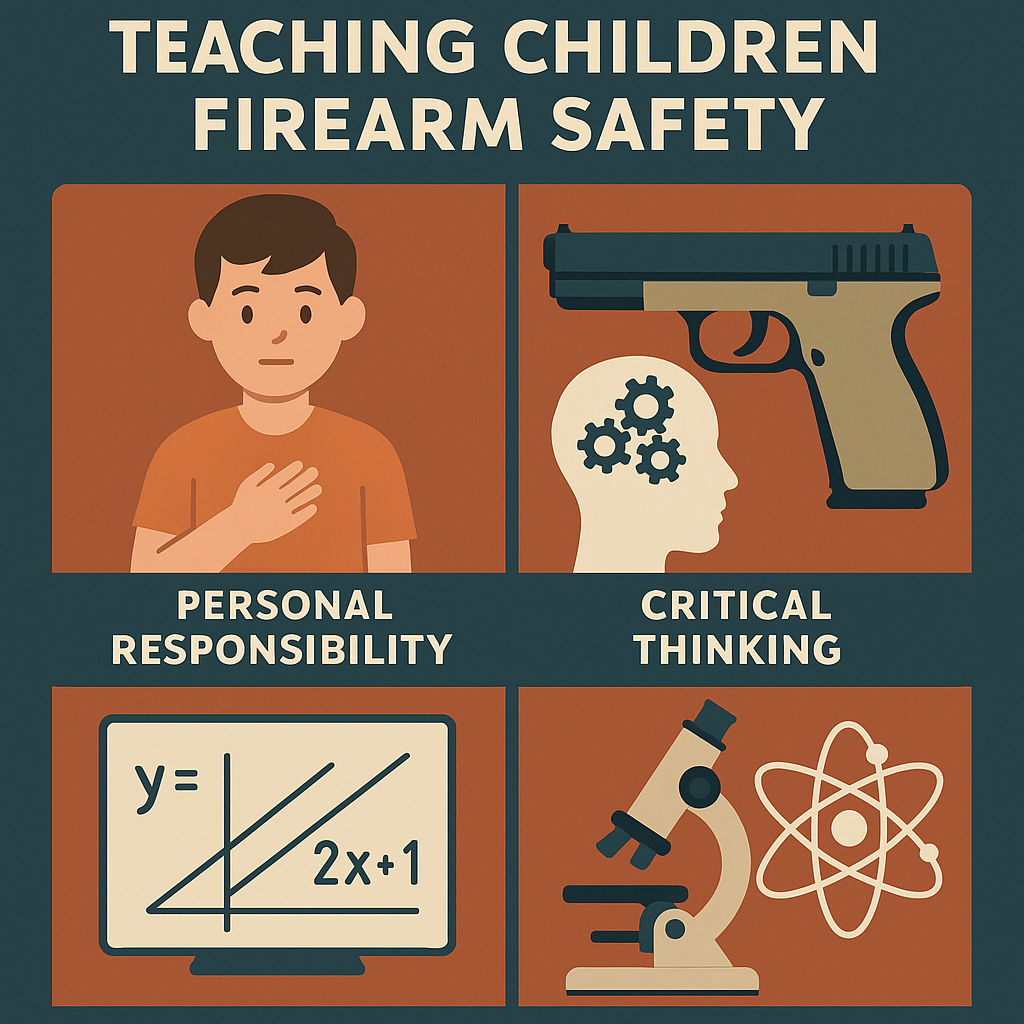
When it comes to protecting our families, knowledge is power—and that includes educating our children about firearms. At Brooks Defense Solutions, we advocate for age-appropriate firearm safety education as a proactive way to reduce accidents, encourage responsibility, and develop critical life skills. But firearm safety offers more than just physical protection. It’s also an opportunity to reinforce values, foster discipline, and teach practical applications of math, science, and reasoning.
Let’s explore the deeper benefits of teaching children firearm safety.
1. Promotes Personal Responsibility and Respect
Firearm safety begins with a foundational lesson: actions have consequences. Children who are introduced to firearm safety—whether they’re ever expected to shoot or not—quickly learn the importance of being accountable for their behavior. This includes following instructions, understanding boundaries, and respecting dangerous tools.
According to the Eddie Eagle GunSafe® Program by the NRA, children as young as pre-kindergarten age can be taught to “Stop! Don’t Touch. Run Away. Tell a Grown-Up” when encountering an unsecured firearm, reinforcing the concept of accountability and self-control.
2. Strengthens Critical Thinking and Decision-Making
Understanding firearm safety requires children to evaluate scenarios and make split-second decisions based on logic and rules. This nurtures situational awareness, pattern recognition, and cause-and-effect thinking.
Children who receive training in safe handling—under supervision—must continually assess conditions:
- Is the firearm loaded?
- Where is the muzzle pointing?
- Is my finger off the trigger?
This awareness enhances their executive function—the brain’s ability to plan, focus, and juggle tasks successfully. Two tools that I recommend utilizing to develop these skills are the SIRT dry fire pistols and launchers from Byrna.
3. Applies Real-World Mathematics
Firearms training is a surprising opportunity to explore practical mathematics:
- Trajectory and angles (geometry)
- Rate of fire, distance, and speed (algebra and arithmetic)
- Measurement of groupings and adjustments (fractions and decimals)
Children involved in shooting sports or even basic training often engage in hands-on math as they calculate distances, manage time during drills, or adjust for wind and drop.
4. Teaches Basic Science Principles
Firearms offer a lens into physics, chemistry, and biology:
- Kinetics – How force and motion work (Newton’s laws)
- Ballistics – The science of projectiles and trajectories
- Combustion – Chemical reactions within ammunition
- Hearing and vision safety – Application of protective gear and anatomy
By demystifying the science behind firearms, children better understand the seriousness of these tools and the importance of respecting them.
5. Reduces Curiosity-Based Accidents
Children are naturally curious. When firearms are forbidden or not discussed, curiosity can become dangerous. Responsible, age-appropriate training turns mystery into understanding, dramatically lowering the chances of a child mishandling a firearm.
A study in the Journal of Adolescent Health shows that children who received hands-on training in addition to verbal instruction were less likely to handle a gun when left alone with one, compared to those who only received verbal warnings.
Source: Grossman et al. (2010). Firearm Safety Education and Children’s Knowledge and Behavior. Journal of Adolescent Health, 46(5), 453-459. doi: 10.1016/j.jadohealth.2009.11.009
6. Builds Confidence and Discipline
Just like martial arts or structured team sports, firearms education—especially through programs like 4-H Shooting Sports or Scholastic Action Shooting Program—instills discipline, patience, and focus. Children develop a sense of pride in mastering skills and adhering to safety protocols, boosting confidence and self-worth.
Final Thoughts
Richard Henry Lee once said “To preserve liberty, it is essential that the whole body of the people always possess arms, and be taught alike, especially when young, how to use them.” At Brooks Defense Solutions, we believe that education is empowerment. Teaching children about firearm safety in a responsible, structured, and science-backed way doesn’t just protect them physically—it develops their minds, reinforces discipline, and prepares them for adulthood with confidence and care.
If you’re interested in enrolling your child in a safety-first firearm education program, reach out to us today or explore our upcoming youth classes and purchase the textbook as an extra resource. Have questions? Reach out via Minnect and Smeeple.
🔐 Knowledge is the first layer of defense. Let’s raise a generation that’s informed, responsible, and ready.


